Representing Clients Throughout Alaska!
Alaska Attorneys Dedicated To You!






Alaska car accidents can happen in seconds and leave victims with serious injuries, costly medical bills, and lasting emotional stress. Busy highways, icy roads, distracted drivers, and severe weather conditions increase the risk of crashes across Alaska. Every day, motor vehicle accidents cause injuries and fatalities that change lives forever.
Drivers must stay alert and focused at all times to protect themselves and their loved ones. Safe driving habits, reduced speeds, and avoiding distractions can help prevent devastating collisions. However, when another driver’s negligence causes harm, injured victims may have the right to seek compensation for medical expenses, lost income, pain and suffering, and other damages.
For more than 30 years, Johnson Law, P.C. has protected accident victims throughout Alaska. Our firm understands the challenges injured drivers and passengers face after a serious crash. We work aggressively to investigate accidents, hold negligent parties accountable, and pursue the maximum compensation our clients deserve.
Drivers who drink and drive or engage in distracted driving put everyone on Alaska’s roads at risk. Under Alaska law, impaired and distracted drivers can be held responsible for the injuries and damages they cause. Serious car accidents often result in painful injuries, mounting medical bills, lost wages, and emotional hardship for victims and their families.
If you or someone you love suffered injuries because of a negligent driver, Johnson Law, P.C. is ready to help. For more than 30 years, our firm has represented car accident victims across Alaska and recovered millions of dollars on behalf of injured clients. We provide aggressive legal advocacy, personalized attention, and dedicated representation to help victims pursue the compensation they deserve after a serious Alaska car accident.
Avoid costly mistakes after an Alaska car accident.
Taking the right steps after an accident can protect your health and strengthen your injury claim. Early action can also improve your ability to recover full compensation. One of the most important parts of any car accident case is proving liability. To recover damages, injured victims must show that another driver’s negligence caused the crash and resulting injuries.
Strong evidence is critical in Alaska car accident claims. Medical records, accident reports, witness statements, photographs, and other documentation can help prove fault and demonstrate the extent of your injuries. Acting quickly also helps preserve important evidence before it is lost or destroyed.
When you contact Johnson Law, P.C., our experienced Alaska car accident attorneys can immediately begin investigating your case. We work quickly to protect your rights and preserve important evidence. Our team gathers records, establishes liability, and pursues maximum compensation for your injuries, lost wages, pain and suffering, and other damages. Initial consultations are free. Do not wait to get the legal guidance you need after a serious Alaska car accident.
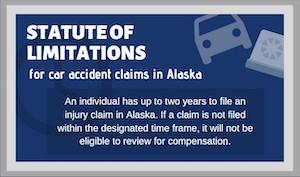
Alaska law limits the amount of time injured victims have to file a car accident lawsuit. This legal deadline is known as the statute of limitations. In most Alaska car accident cases, injured victims have two years from the date of the collision to file a personal injury claim.
Failing to file a lawsuit within the required time period can seriously impact your right to recover compensation. In many cases, courts will dismiss claims filed after the statute of limitations expires. This can prevent injured victims from recovering damages for medical expenses, lost wages, pain and suffering, and other accident-related losses.
Because important deadlines can affect your legal rights, it is important to speak with an experienced Alaska car accident attorney as soon as possible after a crash. Early legal action also helps preserve evidence, protect witness testimony, and strengthen your injury claim.
Car accidents can cause serious physical, emotional, and financial harm. Common injuries after an Alaska auto accident include whiplash, soft tissue injuries, seat belt injuries, cuts, bruises, back injuries, and neck pain. Even injuries that appear minor at first can lead to long-term pain, medical treatment, lost income, and ongoing complications.
Soft tissue injuries are especially common in car crashes and may worsen over time if left untreated. Because insurance companies often try to minimize these claims, injured victims should seek medical care and legal guidance as soon as possible after an accident.
If another driver’s negligence caused your injuries, you may have the right to recover compensation. This may include payment for medical expenses, lost wages, pain and suffering, and other damages. The experienced Alaska car accident attorneys at Johnson Law, P.C. are ready to investigate your case and protect your rights. We fight for the full and fair compensation you deserve after a serious auto accident.
Alaska motor vehicle accidents cause thousands of injuries every year and remain one of the leading causes of serious injury and death across the United States. The Center for Disease Control and Prevention, reports that the US has the highest vehicle crash death rate among high-income countries. According to National Highway Traffic Safety Administration data, millions of car crashes occur annually, resulting in devastating physical, emotional, and financial consequences for victims and their families. Prompt action after a crash can protect your safety, strengthen your injury claim, and preserve critical evidence.
After an Alaska car accident, call 911 immediately and report the collision. Emergency responders and law enforcement help secure the accident scene, protect drivers from additional hazards, and arrange medical treatment when necessary. Police officers also document important evidence that may later support an insurance claim or personal injury lawsuit. When speaking with investigating officers, provide accurate and truthful information about what happened.
If law enforcement does not respond to the scene, you should still report the accident to the appropriate Alaska authorities and comply with all legal reporting requirements. It is also important to notify your insurance company as soon as possible. Many insurance policies require prompt accident reporting, and delays may affect your ability to recover compensation. Early reporting also creates documentation of injuries, vehicle damage, and other losses connected to the crash.
Seeking immediate medical attention after an Alaska car accident is critical, even if your injuries seem minor at first. Conditions such as whiplash, soft tissue injuries, concussions, internal injuries, and back injuries may not show symptoms right away. Adrenaline and shock often mask pain after a serious collision, causing many accident victims to believe they are unharmed when they actually need urgent medical care.
Never tell others you are “okay” before you receive a full medical evaluation from a licensed doctor. Many car accident victims later discover serious injuries hours or even days after a crash. Delaying treatment can place your health at risk and may also weaken your personal injury claim.
If you suffer serious injuries in a motor vehicle accident, seek emergency medical care immediately. Accept ambulance transportation to the hospital when recommended by emergency responders. Prompt medical treatment helps doctors diagnose injuries early, begin proper treatment, and reduce the risk of long-term complications.
Medical records also play a major role in Alaska car accident claims. Emergency room records, physician evaluations, diagnostic testing, and follow-up treatment can help document the extent of your injuries and connect them directly to the crash. This evidence is often essential when pursuing compensation for medical expenses, lost wages, pain and suffering, and other damages.
Always follow your doctor’s treatment plan carefully. Attend all medical appointments, take prescribed medications, follow activity restrictions, and report all symptoms honestly and completely. Consistent medical care protects both your health and your ability to recover fair compensation after an Alaska motor vehicle accident.
Gathering and preserving evidence after an Alaska car accident can significantly strengthen your injury claim. If you can do so safely, record important details at the accident scene. Take photographs and videos of vehicle damage, road conditions, skid marks, traffic signs, weather conditions, visible injuries, and the surrounding area. Strong evidence collected early can help establish fault and support your claim for compensation.
You should also collect important information from everyone involved in the crash. Obtain names, phone numbers, email addresses, driver’s license information, license plate numbers, insurance details, and contact information for witnesses. Accurate documentation can become critical later if liability is disputed.
After leaving the accident scene, continue organizing and preserving all records related to the collision. Keep copies of medical records, accident reports, repair estimates, receipts, wage loss documentation, photographs, videos, and personal notes about your injuries and recovery. Detailed records help demonstrate the physical, emotional, and financial impact of the accident.
Alaska car accident claims often involve multiple insurance companies and different types of insurance coverage. Depending on the crash, compensation may come from liability insurance, uninsured or underinsured motorist coverage, medical payments coverage, or property damage insurance. While available insurance coverage can help pay for medical bills, lost wages, and other damages, insurance companies and adjusters frequently work to minimize payouts and reduce claim values.
Because insurance investigations begin quickly after a serious accident, protecting evidence and documenting your losses is extremely important. An experienced Alaska car accident attorney can help preserve critical evidence, communicate with insurance companies, and pursue the full compensation you deserve after a motor vehicle accident.
After an Alaska car accident, avoid posting about the crash, your injuries, or your recovery on social media. Insurance companies and defense attorneys often monitor Facebook, Instagram, TikTok, X, and other platforms looking for information they can use to challenge injury claims and reduce compensation.
Even harmless photos, comments, videos, check-ins, or status updates may be taken out of context and used against you. A simple post showing daily activities, travel, exercise, or social events could be used to argue that your injuries are not serious. Insurance adjusters may also review emails, text messages, and other online communications during the claims process.
To protect your case, take a break from social media while your injury claim is pending. Avoid discussing the accident, your physical condition, medical treatment, settlement negotiations, or legal matters online. Ask friends and family members not to tag you in posts, photographs, or videos related to your activities or recovery.
Anything you say or post online may later be preserved as evidence and reviewed by insurance companies, attorneys, judges, or juries. Because insurance companies work aggressively to minimize payouts, it is important not to provide information that could weaken your Alaska car accident claim. An experienced Alaska car accident attorney can help protect your rights and guide you through the claims process after a serious motor vehicle accident.
After an Alaska car accident, insurance adjusters and investigators may contact you quickly to discuss the crash and your injuries. These representatives may work for the at-fault driver’s insurance company, your own insurance carrier, or both. While some adjusters may appear friendly and helpful, their primary goal is often to protect the insurance company and limit the amount of compensation paid on your claim.
When speaking with insurance companies, always provide honest and accurate information. However, avoid guessing, exaggerating, or discussing details you do not fully understand. Insurance adjusters carefully review statements, medical records, social media activity, and other evidence looking for ways to reduce or deny claims. Even innocent comments may later be used against you during settlement negotiations or litigation.
You may have a duty to cooperate with your own insurance company after an accident. Still, you should only provide information when you are physically and mentally able to do so accurately. In many cases, you are not legally required to provide a recorded statement to the other driver’s insurance company. Before speaking with an opposing insurance adjuster, it is often wise to consult with an experienced Alaska personal injury attorney.
During all communications with insurance representatives, focus on your medical treatment, recovery efforts, and the ways your injuries affect your daily life, work, and future. Avoid minimizing your injuries or making statements suggesting you have fully recovered before your medical treatment is complete.
Recovering fair compensation after an Alaska motor vehicle accident can be difficult without experienced legal guidance. Insurance companies and defense attorneys work aggressively to limit payouts for medical expenses, lost wages, pain and suffering, and other damages. An experienced Alaska car accident lawyer can protect your rights, handle communications with insurance companies, and fight for the compensation you deserve.
If you are able to safely move around, document the accident to the fullest extent. This means taking pictures at the scene of the collision – your car and theirs. Exchange important information. Take detailed notes of what happened while it is fresh in your mind. The information to collect from the other driver(s) includes driver’s license number, plate number, insurance details, contact information, and full name.
It all comes down to who was careless in their actions. Actions violating traffic laws and putting others in danger are negligent. Negligence often results through distracted, drunk, or reckless driving. Typically, the distracted, drunk or reckless driver is held responsible for resulting damages and/or injuries.
Yes. However, the rule of comparative negligence states that you can still pursue compensation for an accident that was partially your fault. Your decided level of culpability reduces your recovery. Alaska allows plaintiffs to recover damages in an accident as long as they are not responsible for the actual injury. In these cases, injured parties may receive up to 65% of the damages claimed in the accident.
In the majority of rear-end motor vehicle accidents, the accident will be the fault of the driver who hit the car ahead. Common rules of the road encourage drivers to allow room to stop in case of a sudden slow-down in traffic. For this reason, drivers who hit another car from behind may have been driving unreasonably close and are potentially at fault for the collision.
A skilled legal professional makes all the difference after an Alaska car accident. Call Johnson Law at (907)277-3090 or use our contact form to discuss your Alaska car accident injury case. We are here to serve you.
Johnson Law has been serving Alaska car accident injury victims for 30 years.
And while we hope you never need us… We’re here if you do. ~ Doug Johnson
Contact Johnson Law, P.C. today to arrange your FREE case evaluation.