- Free Consultation: (907) 277-3090 Tap Here to Call Us







Distracted Driving Injury Claims


Distracted Driving Injury Claims – Learn how distracted driving can affect Alaska personal injury claims, including evidence, fault, damages, and what injured drivers need to know.
Can Distracted Driving Affect Alaska Personal Injury Claims?
Yes. Distracted driving can affect an Alaska personal injury claim when a driver’s distraction contributed to causing a crash and the resulting injuries. Evidence of cellphone use, texting, screen use, or another distraction may help establish what the driver was doing before the collision and whether that conduct contributed to the crash.
But proving that a driver was distracted is not necessarily the same as proving legal responsibility. A personal injury claim generally requires evidence connecting the driver’s conduct to the collision and the injuries that followed.
What Is Distracted Driving?
Distracted driving occurs when something takes a driver’s attention away from the task of driving.
The Alaska Department of Transportation and Public Facilities (Alaska DOT&PF) describes distracted driving as taking your eyes off the road, hands off the wheel, or mind off driving. Examples include texting or using a handheld device, eating or drinking, interacting with passengers, or adjusting the stereo or navigation system.
Cellphone use is only one form of distracted driving.
A driver can become distracted by many activities. The important issue after a crash is whether the driver’s conduct affected the driver’s ability to operate the vehicle safely.
Can Cellphone Use Be Evidence in an Alaska Car Accident Claim?
Yes. Cellphone use can be relevant evidence in an Alaska personal injury claim.
For example, evidence may help establish that a driver was:
- Texting or reading a message.
- Making or receiving a phone call.
- Using a navigation application.
- Manipulating a cellphone or other electronic device.
- Looking at a screen.
- Engaged in another activity that diverted attention from driving.
Alaska’s highway-safety guidance specifically identifies texting and handheld-device use as forms of distracted driving. Alaska’s current highway-safety program also continues to identify distracted driving as a safety priority.
The State of Alaska’s law against distracted driving, AS 28.35.161, bans reading, typing text messages, emailing, using handheld computers, or operating video/screen devices in view of the driver while a vehicle is in motion.
However, the fact that a driver used a cellphone does not by itself establish that the driver caused a particular crash. The evidence must be evaluated in the context of the collision.
Does Texting While Driving Matter in an Alaska Injury Claim?
It can.
Alaska prohibits texting while driving. The Alaska’s Department of Transportation Office describes Alaska as banning texting while driving and identifies distracted driving as a significant highway-safety concern.
If a driver was texting immediately before a collision, that information may be relevant to determining how the crash occurred.
The important questions may include:
Was the driver using the phone? When was the phone being used? What was the driver doing? Where was the vehicle? And did the distraction contribute to the collision?
Those questions can be more important to a personal injury claim than simply proving that a cellphone was present in the vehicle.
What Evidence Can Prove Distracted Driving In An Alaska Injury Claim?
Evidence in a distracted-driving investigation can come from several sources.
Depending on the circumstances, an investigation may examine:
Cellphone Records
Phone records may help establish whether a call or other communication occurred around the time of a collision.
Witness Statements
Passengers, other drivers, pedestrians, or other witnesses may have seen the driver using a cellphone or otherwise distracted before the crash.
Police Reports
A responding officer may document statements, observations, citations, admissions, or other information concerning possible distracted driving.
Video Evidence
Traffic cameras, business surveillance systems, dash cameras, and other video may capture a driver’s actions immediately before a collision.
Vehicle Data
Some vehicles contain electronic systems that may provide information relevant to the vehicle’s operation before a crash.
Physical Evidence
The location and condition of a vehicle, skid marks, crash damage, roadway evidence, and other physical evidence may help investigators reconstruct what happened.
No single type of evidence is necessarily decisive. The circumstances of each crash determine what evidence may be available and how it should be evaluated.
What If the Driver Was Using a Hands-Free Phone?
Hands-free does not necessarily mean distraction-free.
A hands-free phone conversation may be different from texting or physically manipulating a cellphone, both from a legal and factual standpoint. But a conversation can still divert a driver’s attention from the roadway.
Alaska DOT&PF advises drivers to focus on the road and states that phones and screens can pull a driver’s focus away from driving. Its driver-safety guidance recommends pulling off the road if a driver needs to operate a screened device.
For a personal injury claim, the relevant question is not simply whether the driver was holding a phone.
It may be whether the driver’s conduct contributed to causing the crash.
Does a Distracted Driving Violation Automatically Mean the Driver Is Liable?
No.
A cellphone or distracted-driving violation can be important evidence, but a personal injury claim involves more than establishing that a driver violated a traffic law.
The claim generally requires evidence concerning the driver’s conduct, the circumstances of the collision, causation, and the injuries and damages that resulted.
Alaska law also provides for apportionment of fault when more than one person may be responsible. Under AS 09.17.080, the fact-finder considers both the nature of each person’s conduct and the extent of the causal relationship between that conduct and the damages claimed.
That means the investigation should look at the whole crash, not just one fact.
What If the Injured Driver Was Partly at Fault?
Another driver’s distraction does not necessarily end the analysis if the injured person also contributed to the collision.
Alaska follows a comparative-fault system in which fault can be allocated among responsible parties. Alaska’s Supreme Court recently addressed the application of comparative fault in Kisling v. Grosz, 565 P.3d 226,. 227 (Alaska 2025) explaining that fault is allocated before applying the applicable statutory limit on noneconomic damages.
For that reason, an injured person should not assume that a potential claim disappears simply because there are questions about fault.
The specific facts matter.
What Damages Can Be Part of an Alaska Personal Injury Claim?
Depending on the circumstances, an injury claim may involve losses such as:
- Medical expenses
- Future medical care
- Lost wages or income
- Reduced earning capacity
- Pain and suffering
- Physical impairment
- Disfigurement
- Loss of enjoyment of life
- Other legally recoverable losses
Alaska law places statutory limits on certain noneconomic damages in personal injury and wrongful-death cases, with different provisions depending on the circumstances of the injury.
Because the calculation of damages can be complicated, an injured person should evaluate the potential claim based on the specific facts and applicable law.
How Long Do You Have to File Distracted Driving Injury Claims In Alaska?
In general, Alaska law provides a two-year statute of limitations for personal injury and death claims, unless another law provides otherwise.
That deadline makes it important to address a potential claim promptly.
Waiting can also make evidence harder to preserve. Witnesses may become difficult to locate, video recordings may be overwritten, and electronic evidence may become more difficult to obtain.
If distracted driving may have contributed to a serious collision, preserving evidence early can be especially important.
What Should You Do After a Crash With a Distracted Driver?
If you believe another driver was distracted when your Alaska accident occurred:
- Seek medical attention for your injuries.
- Report the crash when required.
- Photograph the vehicles, roadway, and surrounding area if you can do so safely.
- Identify potential witnesses.
- Preserve photographs, videos, messages, and other information related to the crash.
- Do not assume that the police report contains every piece of evidence that may matter.
- Consider obtaining legal advice before making statements or resolving a serious injury claim.
Evidence can disappear quickly. A prompt investigation may help preserve information that could otherwise be lost.
Injured by a Distracted Driver in Alaska?
If you or a family member was injured in an Alaska car accident and you believe the other driver was distracted, the circumstances of the crash deserve careful examination.
Cellphone records, witness accounts, video, vehicle data, police reports, and other evidence may help determine what happened and whether distracted driving contributed to the collision.
Johnson Law, P.C. represents people injured in motor vehicle accidents throughout Alaska. We investigate serious crashes and help injured Alaskans understand their legal rights and options. If you are injured in a crash caused by a distracted driver, it is important that you hold that person responsible for their negligence. Please call Johnson Law to discuss your loss: (907)277-3090 or use our online contact form.
Johnson Law has been helping Alaskans for nearly 30 years. It’s who we are. And while we hope you never need us… We’re here if you do. ~ Doug Johnson
Understanding Hands-Free and Distracted Driving in Alaska
Hands-free cellphone use while driving in Alaska raises two important questions for Alaska drivers: Is it safe, and is it legal? The answers are not necessarily the same. Our distracted driving series examines both sides of the issue, beginning with why hands-free technology does not eliminate the risks of driver distraction. We then explain Alaska’s cellphone and distracted-driving laws and what drivers should know about prohibited cellphone use. Finally, we examine how distracted driving can affect an Alaska personal injury claim when a driver’s actions contribute to a crash. Together, these articles provide a practical guide to hands-free cellphone use, distracted driving, Alaska law, and the potential consequences of a distracted-driving collision.
Disclaimer: This article series provides general educational information about driving safety in Alaska. However, it is not legal advice and does not create an attorney-client relationship. Because every case is unique, consult a qualified Alaska personal injury attorney about your specific circumstances.
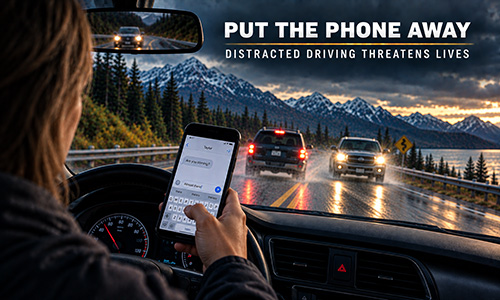
Image generated and modified using ChatGPT – Prompt: Put The Phone Away – Distracted Driving Threatens Lives