- Free Consultation: (907) 277-3090 Tap Here to Call Us







Alaska Pedestrian Accidents


Alaska Pedestrian Accidents – Learn what to do after a pedestrian accident in Alaska, including medical care, evidence, insurance claims, liability, and legal options.
Alaska Pedestrian Accidents: What to Do After an Injury
A pedestrian accident can happen in seconds, but the injuries and financial consequences may last for months or years. Whether a collision occurs at a crosswalk in Anchorage, on a residential street in Fairbanks, or along a rural Alaska road, an injured pedestrian may face medical bills, lost income, and questions about who is responsible.
If a vehicle strikes you while you are walking, knowing what to do next can help protect your health and preserve important information about the accident. Medical care should come first. After that, documenting the collision, understanding insurance coverage, and learning about your legal options can help you make informed decisions.
Johnson Law, P.C., represents injured Alaskans in personal injury matters. This informational guide helps explain what to do after a pedestrian accident in Alaska, how fault may be determined, and when to consider speaking with a personal injury attorney.
What Should You Do After a Pedestrian Accident in Alaska?
After a pedestrian accident in Alaska, seek medical attention, report the collision when appropriate, document what happened, preserve relevant records, and understand your insurance and legal options. Do not assume that an injury is minor simply because you can stand or walk after the collision.
Take these steps when possible.
1. Get to Safety and Call 911
Move away from moving traffic if you can do so safely. If someone is seriously injured in an Alaska pedestrian accident, the scene is dangerous, or emergency assistance is needed, call 911.
Do not move a seriously injured person unless an immediate danger makes movement necessary. Follow the instructions of emergency responders.
If the collision occurs on a busy road, do not put yourself at additional risk by attempting to collect evidence while traffic is moving around you.
2. Seek Medical Attention Promptly
Alaska pedestrian accidents can cause head injuries, fractures, spinal injuries, internal bleeding, and other serious harm. Some symptoms may not appear immediately.
Seek an appropriate medical evaluation after a collision, even if you initially feel relatively well. Follow your healthcare provider’s recommendations and keep records of your treatment.
Medical records can also help document the nature of your injuries and the care you received.
3. Report the Accident
Contact law enforcement when appropriate, particularly when someone is injured or the circumstances require an official response. Provide accurate information about what happened.
Obtain the incident or report number, if available, and ask how to request a copy of the report.
An official report may document the location, people involved, witness information, and observations made by responding officers. However, a report may not establish every fact or determine legal responsibility conclusively.
4. Collect Driver and Witness Information
If you can do so safely, obtain the driver’s name, contact information, vehicle details, and insurance information.
Ask witnesses for their names and contact details. Their observations may help clarify how the collision occurred, particularly if the driver and pedestrian describe events differently.
Do not argue about fault at the scene of an Alaska pedestrian accident. Focus on safety, exchanging information, and obtaining appropriate assistance.
5. Document the Accident Scene
Evidence can become harder to obtain as time passes. If it is safe, take photographs or videos of relevant details, including:
- The location where the collision occurred.
- Crosswalks, intersections, traffic signals, and signs.
- Road conditions, lighting, weather, and visibility.
- Vehicle damage and visible injuries.
- Nearby obstructions, parked vehicles, or snowbanks that may have affected visibility.
Write down what you remember as soon as practical. Include the time, location, direction of travel, and sequence of events.
If nearby businesses, traffic systems, or other sources may have recorded the collision, consider seeking advice promptly about preserving that evidence.
6. Keep Records of Your Injuries and Expenses
After a pedestrian accident in Alaska, create a file for documents related to the accident. Keep medical bills, treatment records, prescription receipts, transportation expenses, and information about missed work.
You may also want to keep notes about pain, mobility limitations, changes to daily activities, and other effects of the injury.
Accurate records can help when reviewing insurance coverage, evaluating losses, and considering a potential personal injury claim.
7. Notify the Appropriate Insurer
Insurance coverage may depend on the circumstances of the collision and the policies involved. You may need to communicate with the driver’s insurer or another insurer that could provide applicable coverage.
Provide accurate information, keep copies of correspondence, and pay attention to requests and deadlines. Before signing a settlement agreement or release, make sure you understand what rights you may be giving up.
If you are uncertain about a request from an insurer or the value of a proposed settlement, consider obtaining legal advice before proceeding.
What Injuries Can Result From a Pedestrian Accident?
Pedestrians have little physical protection when struck by a vehicle. Even a collision at a relatively low speed can cause significant injuries.
Common injuries include:
- Head and brain injuries: A pedestrian may strike the vehicle, pavement, or another surface during a collision.
- Broken bones: The impact can fracture the legs, arms, ribs, pelvis, or other bones.
- Spinal injuries: Damage to the neck or back may require extensive treatment and rehabilitation.
- Internal injuries: Blunt-force trauma can damage internal organs or cause internal bleeding.
- Soft-tissue injuries: Sprains, strains, bruising, and other tissue damage may cause lasting pain or restricted movement.
- Psychological effects: A serious collision can contribute to anxiety, sleep difficulties, or fear of walking near traffic.
The nature and severity of an injury vary from person to person. Prompt medical care can help identify injuries and guide appropriate treatment.
Who May Be Responsible for a Pedestrian Accident in Alaska?
Responsibility for an Alaska pedestrian accident depends on the facts, including the conduct of the driver and pedestrian, traffic conditions, visibility, and applicable law. A driver may be liable if negligent conduct contributed to the collision, but responsibility should not be assumed before the circumstances are evaluated.
Potentially relevant factors include whether a driver:
- Failed to yield when required.
- Was speeding or driving too fast for conditions.
- Was distracted or failed to watch for pedestrians.
- Made a turn without checking for people crossing.
- Failed to respond appropriately to a visible hazard.
The pedestrian’s actions may also be considered. For example, investigators may examine where the pedestrian crossed, the traffic signals, visibility, and whether the pedestrian entered the roadway unexpectedly.
However, a pedestrian’s location or actions do not automatically establish fault. The applicable traffic laws and the specific circumstances matter.
What If the Pedestrian Was Not in a Crosswalk?
A pedestrian accident can occur inside or outside a marked crosswalk. Whether a driver or pedestrian violated a legal duty depends on the location, traffic controls, and circumstances.
Drivers must comply with applicable traffic laws and exercise reasonable care. Pedestrians also have responsibilities when crossing or walking along roadways.
An accident outside a marked crosswalk does not automatically mean the pedestrian has no legal options. Likewise, being struck in a crosswalk does not automatically resolve every question of liability.
Evidence such as witness statements, photographs, traffic signals, and available video may help clarify what happened.
Can You Recover Compensation if You Were Partly at Fault?
Alaska law recognizes comparative fault in claims based on fault. Under Alaska Statute 09.17.060, a claimant’s share of contributory fault reduces compensatory damages proportionately rather than automatically barring recovery.
This means that a pedestrian’s own conduct may affect the amount recoverable, but partial responsibility does not necessarily prevent a claim.
For example, if the evidence suggests that both a driver and a pedestrian contributed to a collision, their respective conduct may need to be evaluated under Alaska law.
The outcome depends on the facts, the available evidence, and the legal rules that apply. An attorney can help assess how comparative fault may affect a particular claim.
What Compensation May Be Available After an Alaska Pedestrian Accident?
Depending on the facts and applicable law, an injured pedestrian may be able to pursue compensation for certain losses related to the collision.
Potential damages may include:
- Medical expenses and reasonable future medical costs.
- Lost wages and other employment-related losses.
- Reduced future earning capacity when supported by the evidence.
- Pain and suffering.
- Losses associated with limitations on daily activities and quality of life.
Not every loss is recoverable in every case, and the value of a claim depends on the injuries, evidence, available insurance, liability, and other circumstances.
Insurance policy limits and disputes about fault or the extent of an injury may also affect the available recovery. A careful evaluation is necessary before estimating the value of a claim.
What if the Driver Who Hit You Has No Insurance?
A pedestrian may have options even when the at-fault driver has no insurance or insufficient coverage. However, the available options depend on the policies and circumstances involved.
Potential sources of coverage may include applicable uninsured or underinsured motorist coverage under an auto insurance policy, subject to the policy terms and Alaska law. Whether coverage applies to a pedestrian’s injuries must be evaluated individually.
Other insurance policies or potential sources of recovery may also be relevant in some cases.
If the driver is uninsured or has limited coverage, preserve the available information and review the situation with an attorney or qualified insurance professional before assuming that no options exist.
How Long Do You Have to File a Pedestrian Accident Claim in Alaska?
Legal deadlines may limit how long an injured pedestrian has to bring a claim. The applicable deadline depends on the type of claim and the circumstances.
Claims involving government entities may have additional requirements or shorter notice periods. Evidence can also disappear well before a filing deadline, so it is wise to investigate a potential claim promptly.
Do not rely on a general deadline without checking how the law applies to your situation. If you have been injured, consider obtaining legal advice as early as practical to identify relevant deadlines and preserve evidence.
When Should You Contact an Alaska Pedestrian Accident Attorney?
Consider speaking with a personal injury attorney if you suffered significant injuries, face substantial medical expenses, missed work, received a disputed insurance decision, or have questions about who was responsible.
Legal guidance may be especially helpful when:
- The driver disputes what happened.
- You believe the driver’s insurer is minimizing your injuries or losses.
- More than one person or entity may have contributed to the accident.
- You may share some responsibility for the collision.
- The driver has no insurance or insufficient coverage.
- You are uncertain about deadlines or settlement documents.
An attorney can review the available evidence, explain potential legal options, identify insurance issues, and help you understand the claims process. Whether a claim is appropriate and what it may be worth depends on the individual circumstances.
Protect Yourself and Understand Your Options
A pedestrian accident can disrupt your health, work, and daily life. Seeking medical attention, documenting the collision, preserving records, and understanding potential insurance coverage can help you make informed decisions about what comes next.
If you were injured while walking in Anchorage, Fairbanks, the Mat-Su Valley, or elsewhere in Alaska, do not assume that you have no options simply because the circumstances are complicated. The facts, evidence, and applicable law determine what may be available.
For additional advice to drivers on preventing collisions as daylight decreases, read our related article, Alaska Fall Driving Safety: How to See Pedestrians in Low Light.
For more information about pedestrian safely during Alaska’s darker months, see our related article on Alaska Pedestrian Safety at Night: How to Stay Visible and Avoid Accidents.
How Johnson Law, P.C., Helps Injured Alaskans
Johnson Law, P.C., represents people injured in accidents throughout Alaska. Attorney Douglas G. Johnson has more than 30 years of experience serving Alaskans and handling personal injury matters and insurance disputes.
After an Alaska pedestrian accident, understanding your rights and the available insurance coverage can be difficult, especially while you are recovering from injuries. Johnson Law can help you evaluate your circumstances, understand the claims process, and determine what steps may be appropriate.
If you or a family member has been injured in a pedestrian accident, consider contacting Johnson Law to discuss your questions and potential options. Please call Johnson Law to discuss your claims: (907)277-3090 or use our online contact form.
Johnson Law has been helping Alaskans for nearly 30 years. It’s who we are. And while we hope you never need us… We’re here if you do. ~ Doug Johnson
Disclaimer: This article series provides general educational information about preparing your vehicle for a safer fall and winter in Alaska. However, it is not legal advice and does not create an attorney-client relationship. Because every case is unique, consult a qualified Alaska personal injury attorney about your specific circumstances.
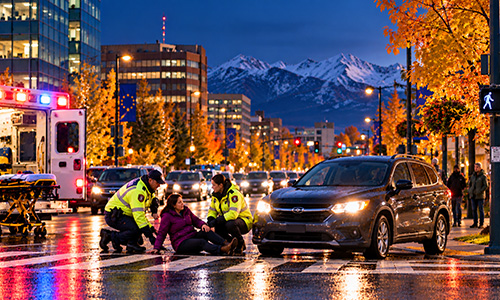
Image generated and modified using ChatGPT – Prompt: Anchorage citizen hurt by a driver in an Anchorage crosswalk on a fall evening