- Free Consultation: (907) 277-3090 Tap Here to Call Us






Alaska Aviation Accident Claims


Alaska Aviation Accident Claims: Key Legal Terms
Quick Answer
Alaska aviation accident claims can involve federal and state laws that differ from ordinary personal injury cases. Furthermore, the legal issues may depend on who operated the aircraft, who was injured, where the accident occurred, and what caused the accident.
For instance, depending on the circumstances, an Alaska aviation injury claim may involve pilot negligence, aircraft maintenance, air traffic control, aircraft defects, operator responsibility, federal aviation regulations, product liability, or other legal issues.
An aviation accident also may trigger an investigation by the National Transportation Safety Board (NTSB) or the Federal Aviation Administration (FAA). However, an aviation safety investigation and a personal injury claim serve different purposes. Namely, the NTSB investigates accidents to determine facts and probable cause and to improve transportation safety; it does not determine who is legally liable for an injury.
Understanding these terms can help injured passengers, pilots, crew members, and families better understand the legal issues that may arise after an Alaska aviation accident.
What Is an Alaska Aviation Accident Claim?
An aviation accident claim is a legal claim seeking compensation for injuries, death, or property damage resulting from an aircraft accident.
Therefore, the responsible party may vary depending on the circumstances. Potentially responsible parties can include:
- Aircraft operators
- Pilots
- Aircraft owners
- Maintenance providers
- Manufacturers
- Parts suppliers
- Air carriers
- Government entities
- Other individuals or businesses
Because aviation accidents can involve multiple parties and overlapping federal and state laws, determining who may be legally responsible requires a careful investigation.
General Aviation Accident
General aviation generally refers to civil aviation operations other than scheduled air services and certain other commercial air transportation operations.
Alaska has extensive general aviation activity, including private flights, air taxis, charter operations, air tours, medical flights, and other aviation operations. The NTSB’s Office of Aviation Safety specifically includes Alaska within its regional investigative structure and investigates general aviation accidents.
The type of aircraft and operation can affect which laws, regulations, and insurance policies apply to an injury claim.
Pilot Negligence
Pilot negligence occurs when a pilot fails to use the level of care required under the circumstances and that failure causes an accident or injury.
Potential examples include:
- Flying while impaired
- Operating an aircraft in an unsafe manner
- Failing to follow applicable procedures
- Improperly responding to changing weather
- Exceeding aircraft limitations
- Failing to maintain adequate situational awareness
Whether a pilot acted negligently depends on the facts, applicable regulations, industry standards, and other evidence.
Aircraft Maintenance
Aircraft maintenance refers to the inspection, repair, servicing, and upkeep required to keep an aircraft and its components in safe operating condition.
A maintenance-related aviation injury claim may involve questions such as:
- Was the aircraft properly inspected?
- Did the maintenance provider follow applicable requirements?
- Did someone overlook a known mechanical problem?
- Was a defective component installed?
- Did improper maintenance contribute to the accident?
Thus, maintenance records, aircraft logs, inspection records, and expert analysis become important evidence in these cases.
Air Traffic Control
Air traffic control (ATC) involves the services and instructions provided to manage aircraft movements and maintain safe separation between aircraft.
An aviation accident may raise questions about air traffic control if, for example, an air traffic controller allegedly provided incorrect information or failed to perform required duties.
Claims involving federal air traffic controllers can present additional legal issues because the United States may be the defendant. In fact, claims based on alleged negligence by FAA employees can fall under the Federal Tort Claims Act (FTCA), which has specific administrative claim requirements.
Federal Aviation Administration Regulations
The Federal Aviation Administration Regulations are federal rules governing aviation safety and operations. They address matters such as aircraft operation, pilot qualifications, maintenance, equipment, and air carrier operations.
A violation of an aviation regulation does not automatically establish civil liability in every case. However, applicable regulations can provide important evidence when investigators and attorneys evaluate how an accident occurred.
Aircraft Defect
An aircraft defect is a problem with an aircraft, component, or system that may contribute to an accident or injury.
A defect may involve:
- Aircraft design
- Manufacturing
- Materials
- Engines
- Propellers
- Flight controls
- Landing gear
- Safety equipment
- Other aircraft components
When a defective product causes an injury, the claim may involve product liability law in addition to other aviation laws.
Product Liability
Product liability involves claims arising from injuries caused by defective or unreasonably dangerous products. In an aviation accident, determining whether a defective product contributed to the crash may therefore become an important part of the investigation.
For example, a product liability claim may involve an aircraft, engine, propeller, avionics system, seat, safety device, or other component. If a defective product contributed to an Alaska aviation accident, the manufacturer, distributor, or another responsible party may potentially be liable for the resulting injuries, depending on the facts and applicable law.
To clarify, potential defendants may include manufacturers, distributors, or other businesses involved in placing the product into the stream of commerce. The specific legal requirements depend on the facts and applicable law.
Operator Negligence
Operator negligence refers to negligent conduct by the person or company responsible for operating an aircraft.
An operator may face legal claims involving issues such as:
- Pilot selection or supervision
- Aircraft maintenance
- Operational procedures
- Safety policies
- Weather decisions
- Training
- Compliance with applicable regulations
Determining operator responsibility requires examining the relationship between the operator, pilot, aircraft owner, maintenance providers, and other parties.
National Transportation Safety Board (NTSB) Investigation
The NTSB investigates civil aviation accidents and selected incidents. Its investigation focuses on determining the facts, circumstances, and probable cause of an accident and developing safety recommendations.
An NTSB investigation may include:
- Examination of the accident site
- Collection of physical evidence
- Aircraft and component examination
- Review of weather information
- Review of maintenance records
- Witness interviews
- Pilot and operational information
- Analysis of aircraft performance
- Review of relevant records and data
Consequently, the investigation can take substantial time. The NTSB explains that general aviation investigations often take 12 to 24 months, depending on their complexity.
Does the NTSB determine who is legally responsible?
No. The NTSB conducts fact-finding investigations to determine probable cause and improve transportation safety. It does not investigate accidents to determine the legal rights, liabilities, or blame of individuals or companies.
This distinction matters. An NTSB report can provide important factual information for a personal injury or wrongful death claim, but the report does not itself determine whether a person or company owes compensation.
NTSB Preliminary Report
An NTSB preliminary report provides factual information gathered during the early stages of an investigation.
Preliminary information can change as investigators collect additional evidence. The NTSB specifically cautions that preliminary information does not contain the complete analysis or final probable-cause determination.
For that reason, an injured person should not assume that a preliminary report provides the final explanation of an accident.
NTSB Final Report
An NTSB final report presents the agency’s analysis, findings, and probable cause after it completes its aviation accident investigation. Unlike the preliminary report, the final report reflects the NTSB’s completed review of the available evidence.
In addition, the report brings together relevant factual information and investigative analysis and may include safety recommendations designed to help prevent similar accidents. Although an NTSB final report can provide valuable information for an injury claim, it does not determine legal liability or the compensation an injured person may recover.
A final NTSB report can provide valuable information when evaluating an aviation injury or wrongful death claim. However, it does not replace a separate legal analysis of liability and damages.
Aviation Accident Evidence
Without a doubt, evidence plays a critical role in determining what caused an aviation accident and who may be legally responsible.
Evidence may include:
- Aircraft maintenance records
- Pilot records
- Flight logs
- Air traffic control communications
- Weather information
- Aircraft data
- Witness statements
- Photographs and videos
- Accident-site evidence
- NTSB investigative materials
- FAA records
- Expert analysis
The NTSB maintains an aviation investigation database that allows the public to search accident and investigation information, including Alaska accidents.
Alaska Aviation Accident Wrongful Death Claims
When an aviation accident causes a death, surviving family members or the estate may have a wrongful death claim, depending on the circumstances and applicable law.
Aviation wrongful death cases can involve complex questions about:
- Who caused the accident
- Which laws apply
- Who may bring the claim
- Available damages
- Insurance coverage
- Federal jurisdiction
- Filing deadlines
Because these cases may involve multiple responsible parties and different legal rules, prompt legal evaluation is important.
Alaska Aviation Accident Claims And The Federal Tort Claims Act
The Federal Tort Claims Act (FTCA), provides a potential legal avenue for certain claims arising from the negligent or wrongful conduct of federal government employees acting within the scope of their employment.
For example, an aviation accident involving alleged negligence by an FAA employee may raise FTCA issues. The FAA explains that claims against the United States based on alleged negligence or wrongful conduct by FAA employees must satisfy specific administrative requirements before a lawsuit can proceed.
These requirements can differ from the rules that apply to claims against private pilots, aircraft operators, or companies.
Alaska Aviation Accident Claims And Aviation Insurance
Aviation insurance can provide coverage for aircraft owners, operators, businesses, and other aviation-related risks. After an accident, however, determining which policies apply can be just as important as determining who caused the accident.
The available coverage depends on several factors, including the policy language, the insured parties, the type of aircraft operation, and the circumstances of the accident. For that reason, reviewing all potentially applicable insurance policies can play an important role in evaluating an Alaska aviation injury claim and identifying potential sources of compensation.
Why Aviation Accident Claims Require Specialized Legal Knowledge
Aviation accident cases can involve much more than determining who caused a crash. Moreover, the investigation may require analysis of aircraft operations, maintenance, weather, pilot conduct, federal aviation regulations, air traffic control, aircraft design, and other technical issues.
In addition, the law that applies can depend on the type of flight, the parties involved, and the location and circumstances of the accident.
For an Alaska aviation injury claim, identifying the applicable law and potential sources of compensation early can help protect important evidence and legal rights.
Continue Exploring Alaska Personal Injury Law
Continue exploring this Alaska Personal Injury Glossary series to learn more about:
- Alaska Personal Injury Basics
- Alaska Damages And Compensation Explained
- Alaska Insurance Claims
- Alaska Court and Litigation Terms
- Alaska Maritime Injury Terms
- Alaska Wrongful Death Claims
- Alaska Survival Claims
These articles explain additional legal terminology you may encounter during an Alaska personal injury claim.
Disclaimer: Please note: This article provides general educational information about Alaska aviation accident claims and related legal concepts. However, it is not legal advice and does not create an attorney-client relationship. Because every case is unique, consult a qualified Alaska personal injury attorney about your specific circumstances.
Johnson Law, P.C. has been helping injured Alaskans and those injured while visiting Alaska for 30 years. It’s who we are. And while we hope you never need us… We’re here if you do. ~ Doug Johnson
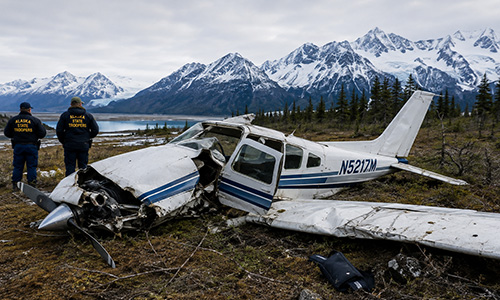
Image generated and modified using ChatGPT – Prompt: Small Plane Crash In Alaska