- Free Consultation: (907) 277-3090 Tap Here to Call Us







Alaska Court And Litigation Terms


Alaska Court and Litigation Terms: Learn about complaints, discovery, depositions, mediation, trials, judgments, appeals, and more.
Quick Answer
If an Alaska personal injury claim does not settle, the case may proceed through the court system. Understanding the legal terms used during a personal injury lawsuit can help you follow what happens at each stage. This glossary explains common Alaska court and litigation terms, including complaints, answers, discovery, depositions, motions, mediation, arbitration, expert witnesses, trials, verdicts, judgments, and appeals.
The Alaska Rules of Civil Procedure establish the procedures parties and judges generally follow in Alaska civil cases. The Alaska Court System also maintains separate rules for appeals, evidence, and other types of proceedings.
What Does The Term Parties Mean In Alaska Court And Litigation Terms?
Plaintiff
The plaintiff is the person or entity that brings a lawsuit.
In a personal injury case, the injured person generally serves as the plaintiff. In some cases, another person or representative may bring a claim, such as a wrongful death action.
Defendant
The defendant is the person or entity accused of causing the plaintiff’s injury or otherwise being legally responsible for the plaintiff’s losses.
A personal injury lawsuit can involve more than one defendant when multiple parties may share responsibility.
Documents Used In An Alaska Personal Injury Claim Lawsuit
What Are Pleadings?
Pleadings are formal court documents in which the parties state their claims and defenses.
The complaint and answer are common examples. Pleadings help establish the issues that the court may need to resolve.
1. Complaint
The complaint starts the civil lawsuit. It identifies the parties, states the plaintiff’s legal claims, and explains the relief or damages sought. Alaska Civil Rule 7 identifies the complaint and answer as the primary pleadings in a civil case.
2. Summons
The summons formally notifies the defendant that a lawsuit has been filed and requires the defendant to respond. The Alaska Court System provides a standard civil summons form.
3. Answer
The defendant files an answer to respond to the allegations in the complaint. The answer may also raise defenses and, when appropriate, counterclaims.
4. Motions
A motion is a formal request asking a judge to make a ruling or take a specific action in a case.
For example, a party may file a motion asking the court to:
- Require another party to provide discovery
- Exclude certain evidence
- Resolve a legal issue
- Grant summary judgment
- Take another action permitted by the court rules
Alaska Civil Rule 77 generally governs motion practice in civil cases.
5. Responses and Replies to Motions
When one party files a motion, the opposing party may file a response or opposition. The moving party may then have an opportunity to file a reply. Alaska’s civil forms include separate documents for motions, responses, replies, and orders.
6. Affidavits and Declarations
A party may file an affidavit or other sworn statement to provide factual information supporting a motion or other filing. Alaska’s civil forms include a standard affidavit form.
7. Discovery-Related Documents
8. Proposed Orders and Court Orders
Parties may submit proposed orders for the judge to consider. The court can then issue an order resolving a motion or directing the parties to take a particular action. Alaska’s civil forms include orders on motions and summary judgment.
9. Settlement Documents
When the parties settle a case, they may file documents reflecting the settlement and asking the court to dismiss the case or take another appropriate action. The exact documents depend on the circumstances of the settlement.
10. Judgment
A judgment formally establishes the court’s final decision and, when appropriate, the amount one party must pay another. Alaska’s civil forms include judgment documents and documents addressing satisfaction of judgments.
11. Notice of Appeal
If a party seeks appellate review, that party generally files a notice of appeal and other required appellate documents. Alaska’s appellate procedures also involve documents such as a docketing statement and designation of transcript.
What Are Discovery-Related Alaska Court And Litigation Terms?
Discovery is the process through which the parties exchange information and gather evidence before trial. Alaska Civil Rules 26 through 37 address discovery procedures, including disclosures, interrogatories, requests for production, and depositions.
Discovery may involve:
- Medical records
- Employment records
- Photographs and videos
- Accident reports
- Witness information
- Insurance information
- Written questions
- Requests for documents
- Depositions
Discovery helps both sides evaluate the evidence and prepare their cases.
Interrogatories
Interrogatories are written questions that one party sends to another party during discovery.
The receiving party generally must provide written answers according to the applicable rules and deadlines. Interrogatories can help establish facts about an accident, injuries, medical treatment, employment, and other issues relevant to the lawsuit.
Request for Production
A request for production asks another party to provide documents, electronically stored information, or other materials relevant to the case.
For example, a personal injury case may involve requests for medical records, photographs, communications, employment records, or other evidence.
Deposition
A deposition is a formal question-and-answer session in which a witness gives testimony under oath outside the courtroom.
Attorneys may question parties, witnesses, and experts during depositions. A court reporter generally creates a transcript of the testimony.
Because deposition testimony can become important evidence in a personal injury case, preparing carefully and answering questions truthfully matters.
Evidence
Evidence consists of information that the parties use to prove or disprove facts in a lawsuit.
Alaska personal injury case evidence may include:
- Medical records
- Photographs
- Videos
- Police reports
- Witness testimony
- Expert testimony
- Employment records
- Physical evidence
- Electronic communications
The Alaska Rules of Evidence govern what evidence courts may consider and how parties present it.
Expert Witness
An expert witness is a person with specialized knowledge, education, training, or experience who provides opinions on issues that require expertise.
Personal injury cases may involve experts such as:
- Physicians
- Surgeons
- Rehabilitation specialists
- Vocational experts
- Economists
- Accident reconstruction specialists
- Engineers
Experts can help explain the cause and extent of an injury, future medical needs, lost earning capacity, accident mechanics, and other technical issues.
In Alaska, expert witnesses are primarily governed by Alaska Rule of Civil Procedure 26(a)(2) for disclosures and discovery, and Alaska Rule of Evidence 702 for admissibility and qualifications.
How Do Cases Resolve In Alaska Court And Alaska Litigation?
Summary Judgment
Summary judgment is a procedure that can resolve some or all of a case without a trial when the applicable legal and factual requirements are met.
A party seeking summary judgment argues that the undisputed facts and applicable law require the court to rule in that party’s favor. Summary judgment can become an important issue when the parties agree about significant facts but disagree about how the law applies.
Mediation
Mediation is a process in which a neutral mediator helps the parties negotiate a possible settlement.
Unlike a judge, a mediator generally does not decide who wins the case. Instead, the mediator helps the parties communicate, identify disputed issues, and explore possible solutions.
Mediation can occur before or during litigation. Alaska’s Civil Rule 100 provides a mechanism for court-ordered mediation after a complaint has been filed when the court determines mediation may help achieve a settlement.
Arbitration
Arbitration is a dispute-resolution process in which an arbitrator considers the parties’ positions and evidence and makes a decision according to the applicable arbitration agreement and rules.
Mediation and Arbitration differ because the arbitrator may have authority to decide the dispute, while a mediator generally helps the parties reach their own agreement.
Whether arbitration applies to an Alaska personal injury dispute depends on the facts, agreements between the parties, and applicable law and rules.
Trial
A trial is the formal court proceeding in which the parties present evidence and legal arguments to resolve disputed issues.
Depending on the case, a judge or jury may decide the factual issues. Attorneys may present opening statements, question witnesses, introduce evidence, make legal arguments, and deliver closing arguments.
Not every Alaska personal injury lawsuit reaches trial. Many cases resolve through settlement or other dispute-resolution processes before trial.
How Is An Alaska Personal Injury Claim Outcome Determined?
Verdict
A verdict is the decision reached by a judge or jury on the issues submitted for decision at trial.
In a personal injury case, a verdict may address questions such as whether the defendant was responsible for the injury and, if so, the amount of damages.
Judgment
A judgment is the court’s formal decision that resolves a case or establishes the amount or relief owed.
A verdict and judgment are related but not identical. A verdict represents the decision on the issues submitted at trial, while the judgment is the formal court order that gives legal effect to the result.
What Happens If A Party Disagrees With A Claim’s Outcome?
Appeal
An appeal asks a higher court to review a lower court’s decision for legal error.
An appeal is not a new trial. The appellate court generally reviews the existing record and the legal issues raised on appeal rather than hearing new evidence.
In Alaska, appeals from Superior Court decisions generally proceed under the Alaska Rules of Appellate Procedure. The Alaska Court System provides specific requirements for starting an appeal, including filing a notice of appeal and other required documents.
Appellant and Appellee
The appellant is the party who asks the higher court to review a lower court decision.
The appellee is the party responding to the appeal.
Why Alaska Court and Litigation Terms Matter
As a personal injury case moves through the legal system, unfamiliar terminology can make the process seem more complicated than it is. Understanding these basic terms can help you follow your case, communicate with your attorney, and understand the purpose of each stage of litigation.
The specific procedures, deadlines, and legal strategies can vary significantly from one Alaska personal injury case to another. The applicable court rules also change over time, so current Alaska rules should be consulted when specific procedural requirements matter. The Alaska Court System publishes the current Alaska Rules of Court and identifies recent rule changes.
Continue Exploring Alaska Personal Injury Law
Continue exploring this Alaska Personal Injury Glossary series to learn more about:
- Alaska Personal Injury Basics
- Alaska Damages And Compensation Explained
- Alaska Insurance Claims
- Alaska Maritime Injury Terms
- Alaska Aviation Accident Claims
- Alaska Wrongful Death Claims
- Alaska Survival Claims
These articles explain additional legal terminology you may encounter during an Alaska personal injury claim.
Disclaimer: Please note: This article provides general educational information about Alaska court procedures and personal injury litigation. However, it is not legal advice and does not create an attorney-client relationship. Because every case is unique, consult a qualified Alaska personal injury attorney about your specific circumstances.
Johnson Law, P.C. has been helping injured Alaskans and those injured while visiting Alaska for 30 years. It’s who we are. And while we hope you never need us… We’re here if you do. ~ Doug Johnson
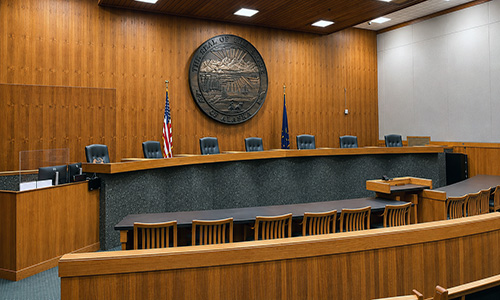
Image modified using ChatGPT – Prompt: The Alaska Supreme Court Courtroom